Unlocking Workforce Potential:
The Role of Quality of Life in Driving Organizational Performance
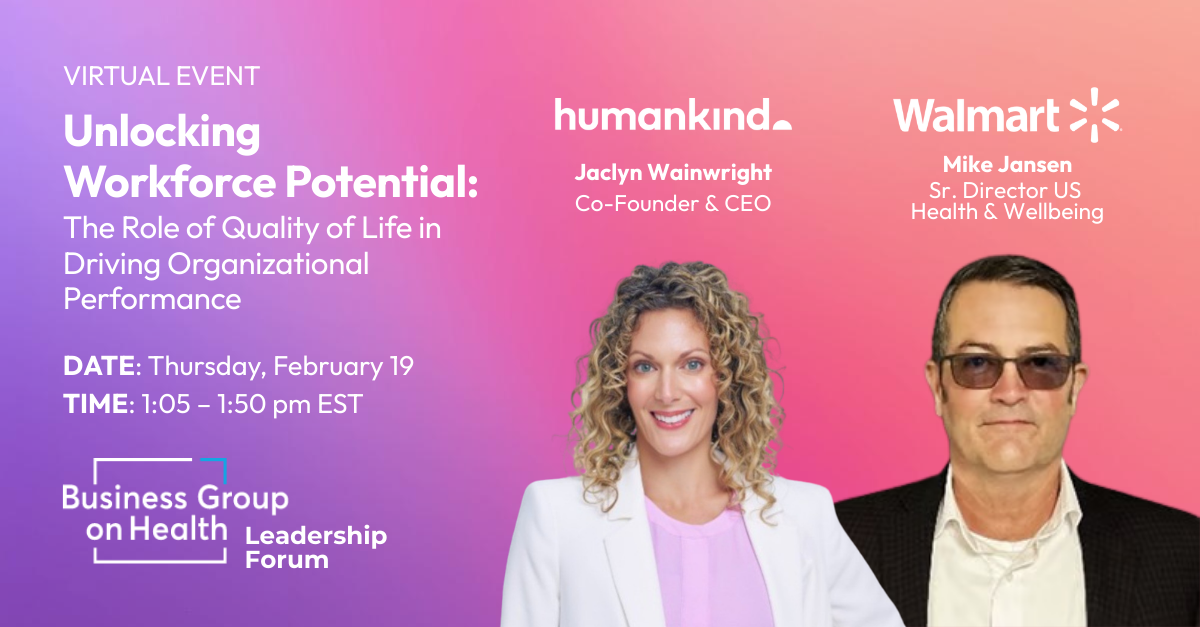
The Business Group on Health Leadership Forum on Employee Experience held its first-closed door meeting of the year, a virtual event featuring a presentation by Walmart’s Mike Jansen, Senior Director US Health & Wellbeing, and Jaclyn Wainwright, Humankind Co-founder & CEO, for a conversation about workforce stress, proactive outreach, and what becomes possible when employers measure Quality of Life — not just utilization.
The discussion reflected a shared commitment to strengthening how employees experience work, especially during moments that matter.
Key themes from the session:
Workforce stress is directly impacting performance.
Life challenges distract and affect employees at work, reducing focus, problem solving, and collaboration.Proactive outreach helps employees access existing benefits.
Even strong programs can go underutilized without timely, human intervention to help guide employees and their families.Human connection drives engagement.
The power of connection, support and accountability are unmatched in helping individuals make meaningful change and building sustainable resilience.
Quality of Life is a better measure than just utilization and engagement.
QoL correlates with improved cost of care, retention and resilience.
Leadership alignment builds confidence and trust.
When managers understand the approach and have the tools and resources to support their teams in moments of crisis, employees are more likely to engage.

The Reality Employers are Facing
Workforce stress is not abstract — it shows up in performance, engagement, and resilience.
Shrinking support networks and day-to-day pressures mean many employees are navigating challenges quietly. Younger workers, in particular, report that life stressors directly affect how they perform at work.
As Jaclyn shared:
“It doesn’t matter where stress is coming from. If it’s there, it impacts cognitive performance, emotional resilience, and productivity.”
Quality of Life shapes how employees experience work — and how they show up within it.
RETHINKING ACCESS
A Shift Toward Proactive Support
Before Humankind and Walmart began working together, strong benefits and resources were already available to Associates. The opportunity wasn’t to add more programs, but to help more people connect to the support already in place — especially in moments of high stress and anxiety while navigating complex systems.
During the session, Mike described a challenge many employers recognize: employees don’t always raise their hand when they need help. They may be unsure where to start, unaware support applies to their situation, or simply stretched too thin to take the first step.
That realization led to a different way of thinking about access.
Rather than expecting employees to navigate resources on their own, proactive outreach shifts responsibility for the first move. A real person - not a bot or automated message - reaches out, creating a simple starting point and offer for a helping hand, and a shoulder to lean on. This lets someone in need simply accept support when help is needed most, rather than requiring them to have the courage to seek it out.
Trust builds over time. Not everyone answers the first call, and that’s expected. With consistent outreach, leadership awareness, and clear communication, employees begin to understand what the outreach is and why it exists.
The shift is subtle but meaningful: support reaches employees, rather than waiting for them to search for it.
“The tenacity of the Humankind team doesn’t go away.”
— Mike Jansen,
Sr. Director US Health & Wellbeing, Walmart

Measuring What Matters
Another theme that emerged during the session was how employers define impact.
Traditional measures often focus on participation - simply defining success by “access”, measured in sign-ups, downloads and log-ins. The conversation explored a different perspective: whether an employee’s day-to-day experience is improving over time.
Humankind approaches this through changes in Quality of Life measured from a baseline across multiple domains. Rather than asking who engaged, the focus shifts to a more meaningful question: are people doing better?
As Jaclyn shared:
“We’re able to see meaningful Quality of Life changes within months.”
Continuing the Conversation
The Leadership Forum created space for an honest discussion about how employers can better support their workforce, not by adding complexity, but by strengthening connection to the resources already in place.
We’re grateful to Business Group on Health for convening the dialogue, and to Mike for sharing his insights and perspective.
Improving Quality of Life is ongoing work grounded in listening, learning, and meeting employees where they are.
If these ideas reflect challenges your organization is navigating, we’d welcome the opportunity to continue the conversation.
Learn more about Humankind
Find out how we can transform the quality of life for your workforce.